I know that we all have had that gorgeous experience of listening to a song that explains exactly what we feel. It’s amazing, I know. But what’s even more amazing is that a person can have the admirable capacity of putting such feelings into words and, moreover, into a song! We tend to think that one cannot go beyond that. And yet, some do. There are singers that can not only write incredibly touching songs, but also interpret them as if they were dying on stage!
Once upon a time Elvis Costello wrote a perfect song. A true work of art. A piece with so much feeling that, sung by him, was thought to be glorious and unbeatable. But one day, he invited Fiona Apple to sing it and she proved everyone wrong.
The song is called “I want you”. It tells the story of a boy who is deeply in love with a girl but she betrays him, and the boy’s love becomes an obsession. He uses the words “I want you” in order to hide his “I love you”, which causes him so much pain.
Luckily, I have never been in that situation, but Fiona surely has. Or maybe she’s the best actress in the whole world and knows like no one on earth how to play a character. I have never seen someone get so much into the song. Her angelical flawless face starts to transform and she ends up looking as a total psycho. When the song is over, she can’t even smile at the applause of the audience.
I would really like you to take a look at this amazing video and tell me what you think of it. I’m also sharing with you the lyrics in a google doc.
Enjoy!
Tuesday, 31 August 2010

Popcorn: Don’t you love it madly?

Last Friday I went to the cinema to watch “Inception” (kick-ass film!) and that got me to think about why is it that we eat popcorn when we watch movies. Personally, whenever I go to the cinema I buy popcorn. For me, eating it and watching the film go hand in hand. And, while searching the net to find information about this awesome “tradition”, I found a great description of such an experience: “Somehow the movie-going experience is incomplete without that tub of buttery, crunchy goodness getting all over your shirt as you munch away in the dark”.

It all started when street vendors pushed their carts near theatres and found there a very good source of income. Theatre owners hated popcorn because it made a mess all around, and also, because people would go out in the middle of the shows to buy it. This was so until they realized it could be them who would profit from this sweet marvel.
In 1925 the first electric popcorn machine was sold to movie theatre owners and it was definitely there to stay. During the Great Depression, buying popcorn was one of the very few “luxuries” people could afford. Theatre owners even lowered the price of movie tickets, so, the result was that going to the cinema was the most economic night out one could have. Movie tickets and popcorn were two of the very few products that raised their sales immensely during that rough time. During WWII, sugar was sent to American troops, so there was not much sugar left in the country to produce candy. As a consequence, people ate three times more popcorn than usual. And in the 1950's the amount of money made from popcorn exceeded the amount made from movies themselves.

Today, selling popcorn and other snacks are far more profitable for theatres than selling tickets. One reason for this is that theatres have to split in halves the money of the tickets with studios. And the other reason is probably that popcorn is so absolutely delicious you can never get enough, can you?
Sources:
A History of Popcorn and Movies
History and Legends of Popcorn, Cracker Jacks & Popcorn Balls
Wednesday, 18 August 2010
What’s wrong about being alone?
I came across a video in which Canadian poet-songwriter-singer Tanya Davis performs and recites her poem “How to be alone”. And, after watching it and reading and re-reading every phrase in that genuine work of art, I couldn’t help but thinking deeply in this being-alone thing.
The poem can be said to summarize in more or less 50 lines what hundreds of self-help books have been trying to explain to people. It is like a simple manual to teach how to enjoy being by yourself, to see the positive side of being alone, to like your own company. The author shares with us a step-by-step guide to show ourselves alone to the world and be happy with it. Therefore, the piece is not only a combination of exquisite subtle rhymes, gorgeous ideas, and a realization of the hope of finding great modern poets, but also a group of words that go far beyond and may work as a life buoy when you feel you’re drowning.
There’s a part of the poem that says: “Society is afraid of alone though. Like lonely hearts are wasting away in basements. Like people must have problems if after a while nobody is dating them.” Isn’t this incredibly true? But why is that so? What is in being with someone that makes us more “normal”? Why do we all grow up with the idea of finding a partner? Do we really need it or is that what we are imposed? I’m not saying being with someone is not nice. I love being with my boyfriend as well as with my friends, family, partners, students, etc. But what’s wrong with me if I choose not to be with anybody?
Looking at some dictionary entries, I’ve found many different meanings of the word “loneliness”, and the one I prefer is:
“A feeling of depression resulting from being alone”
But I needed a word that shared the meaning of being alone, but expressed different feelings. So I thought about “solitude”, which means:
“When you are alone, especially when this is what you enjoy”
That’s why, I guess being alone is not the actual problem, but how we feel about is the crux of the matter.
I you have ten minutes to spare, do watch the video and read the poem. You never know if it can cheer you or a friend up.
The poem can be said to summarize in more or less 50 lines what hundreds of self-help books have been trying to explain to people. It is like a simple manual to teach how to enjoy being by yourself, to see the positive side of being alone, to like your own company. The author shares with us a step-by-step guide to show ourselves alone to the world and be happy with it. Therefore, the piece is not only a combination of exquisite subtle rhymes, gorgeous ideas, and a realization of the hope of finding great modern poets, but also a group of words that go far beyond and may work as a life buoy when you feel you’re drowning.
There’s a part of the poem that says: “Society is afraid of alone though. Like lonely hearts are wasting away in basements. Like people must have problems if after a while nobody is dating them.” Isn’t this incredibly true? But why is that so? What is in being with someone that makes us more “normal”? Why do we all grow up with the idea of finding a partner? Do we really need it or is that what we are imposed? I’m not saying being with someone is not nice. I love being with my boyfriend as well as with my friends, family, partners, students, etc. But what’s wrong with me if I choose not to be with anybody?
Looking at some dictionary entries, I’ve found many different meanings of the word “loneliness”, and the one I prefer is:
“A feeling of depression resulting from being alone”
But I needed a word that shared the meaning of being alone, but expressed different feelings. So I thought about “solitude”, which means:
“When you are alone, especially when this is what you enjoy”
That’s why, I guess being alone is not the actual problem, but how we feel about is the crux of the matter.
I you have ten minutes to spare, do watch the video and read the poem. You never know if it can cheer you or a friend up.
Thursday, 12 August 2010
Cartoon Time
I have always admired the wit and the inventiveness of many cartoonists, but what I admire the most is their capacity to draw. I guess that’s an inborn talent that I wasn’t provided with, and just have to face it. It has its positive side too, though: my students roar with laughter whenever I draw something on the board. That’s how terrible I am at drawing.
This tool I’ve recently learned to use rid me of the main obstacle between me and the cartoonists’ world. And I’ve discovered that, when making a cartoon, one can criticize in a softer way. We all may have some opinions that we choose not to share because we are afraid they might hurt others’ feelings. But through drawings, almost everything can be said. It seems to me that this is a face-saving world, isn’t it?

My cartoon is mainly about chauvinism. Lately, there has been a lot of discussion about gay marriage, and prejudices against homosexuality have abounded. But what I hate the most is that men’s sheer hypocrisy to protest against gay couples, while they are immensely turned-on by lesbians. How come that girl-and-girl couples are hot, and boy-and-boy couples are disgusting? What is with that sick and incoherent way of thinking men have? How does that work? Well, I guess we will never know because even they cannot explain it. What they can do is to do us, and themselves, a favour and zip it when it comes to discussions on homosexuality.
Anyway, I hope you like my cartoon as much as I enjoyed making it.
Thanks for reading!
This tool I’ve recently learned to use rid me of the main obstacle between me and the cartoonists’ world. And I’ve discovered that, when making a cartoon, one can criticize in a softer way. We all may have some opinions that we choose not to share because we are afraid they might hurt others’ feelings. But through drawings, almost everything can be said. It seems to me that this is a face-saving world, isn’t it?

My cartoon is mainly about chauvinism. Lately, there has been a lot of discussion about gay marriage, and prejudices against homosexuality have abounded. But what I hate the most is that men’s sheer hypocrisy to protest against gay couples, while they are immensely turned-on by lesbians. How come that girl-and-girl couples are hot, and boy-and-boy couples are disgusting? What is with that sick and incoherent way of thinking men have? How does that work? Well, I guess we will never know because even they cannot explain it. What they can do is to do us, and themselves, a favour and zip it when it comes to discussions on homosexuality.
Anyway, I hope you like my cartoon as much as I enjoyed making it.
Thanks for reading!
Thursday, 29 July 2010
Who do you prefer teaching?
This may be a tough question for you, but I’m pretty sure you all have a favourite. Or at least, at times, you do. The options are, of course: children, teenagers and adults; and even our course of studies draws a fundamental difference between the groups. If you ask me, in this one, just like in many other aspects of life, I always prefer learning about something, as well as observing it in action, before jumping to conclusions. And that’s what I’ve done. So now, I can say I’ve made up my mind… partially.
If there’s one thing that’s clear in my head is that the last place on my ranking is indisputably occupied by teenagers. There was one year in which both of the groups I was teaching to were 2nd Adol. I have to admit that I sometimes miss them (just a little bit) and think about what their lives may be like now, but I really don’t want to go back to them. It’s not that they were the most hateful human beings on earth; they were actually pretty nice people to surround yourself with. The problem there was me. I can’t help feeling close to students, and making them feel they can trust me and that we can even be friends. And I’m afraid that that’s a huge mistake to make around adolescents. Once they see you as their friend, you’re no longer the authority within the classroom.
Since last year, I’ve been in front of a group of adults, and let me tell you I’ve never felt more comfortable. I think that the main reason why I immensely enjoy working with them is because, in that context, I see the process of teaching as pure as it can be. I mean, I rack my brains trying to find the best way of making vocabulary memorable for them, and of leaving no doubts as regards a grammar topic. The obstacles are the difficulties the students may encounter when dealing with grammatical points. But that, for me, is natural, is implied in the literal meaning of “teaching”. The pragmatic aspect of the word shows us, teachers, having to ask our students to be quiet, pay attention, do the homework, and so on and so forth. Adults are part of our classes because they want to, or need to. If they don’t fulfill their responsibilities it’s their problem, not mine. So, when I’m teaching English to my adults, I don’t see myself as the authority; I let myself be and become a friend helping other friends to learn.
Children are, IMO, the most challenging students one can be faced with. I’ve also been working with the same group since last year, and I cannot beat the constant fear I have whenever I have to teach a tense. I’m so afraid of making one little mistake that can never be erased. Of course it is incredibly rewarding when I see them producing correct sentences, but I always feel I could have done more. The other negative aspect of teaching them is their misbehavior. But just when I think I can’t take it anymore, they make me laugh. Sometimes I find myself laughing so hard that I can’t even speak to scold them. It’s an amazing feeling.
To conclude, I’d like to share with you two forums (eslHQ, abrsm) I’ve found in which the question in the title is discussed. There are some very interesting opinions. And there was one phrase about children turning into adolescents that, I think, is great:
“Once they turn 13 or so, as the enthusiasm begins to lose out to self-consciousness, my interest begins to wane as well. Plus it's not longer funny if I act like a goof. ”
If there’s one thing that’s clear in my head is that the last place on my ranking is indisputably occupied by teenagers. There was one year in which both of the groups I was teaching to were 2nd Adol. I have to admit that I sometimes miss them (just a little bit) and think about what their lives may be like now, but I really don’t want to go back to them. It’s not that they were the most hateful human beings on earth; they were actually pretty nice people to surround yourself with. The problem there was me. I can’t help feeling close to students, and making them feel they can trust me and that we can even be friends. And I’m afraid that that’s a huge mistake to make around adolescents. Once they see you as their friend, you’re no longer the authority within the classroom.
Since last year, I’ve been in front of a group of adults, and let me tell you I’ve never felt more comfortable. I think that the main reason why I immensely enjoy working with them is because, in that context, I see the process of teaching as pure as it can be. I mean, I rack my brains trying to find the best way of making vocabulary memorable for them, and of leaving no doubts as regards a grammar topic. The obstacles are the difficulties the students may encounter when dealing with grammatical points. But that, for me, is natural, is implied in the literal meaning of “teaching”. The pragmatic aspect of the word shows us, teachers, having to ask our students to be quiet, pay attention, do the homework, and so on and so forth. Adults are part of our classes because they want to, or need to. If they don’t fulfill their responsibilities it’s their problem, not mine. So, when I’m teaching English to my adults, I don’t see myself as the authority; I let myself be and become a friend helping other friends to learn.
Children are, IMO, the most challenging students one can be faced with. I’ve also been working with the same group since last year, and I cannot beat the constant fear I have whenever I have to teach a tense. I’m so afraid of making one little mistake that can never be erased. Of course it is incredibly rewarding when I see them producing correct sentences, but I always feel I could have done more. The other negative aspect of teaching them is their misbehavior. But just when I think I can’t take it anymore, they make me laugh. Sometimes I find myself laughing so hard that I can’t even speak to scold them. It’s an amazing feeling.
To conclude, I’d like to share with you two forums (eslHQ, abrsm) I’ve found in which the question in the title is discussed. There are some very interesting opinions. And there was one phrase about children turning into adolescents that, I think, is great:
“Once they turn 13 or so, as the enthusiasm begins to lose out to self-consciousness, my interest begins to wane as well. Plus it's not longer funny if I act like a goof. ”
Tuesday, 27 July 2010
General knowledge is the basis (Thank God EGB is gone!)
Throughout the years, we have seen innumerable attempts to improve the educational system. Every time school programmes are about to undergo a certain kind of change, the same question is raised: should students be instructed in a particular area according to what they want to work in, or should they be provided with knowledge about many different aspects of life so as to know a bit of everything? The latest modification carried out in the Argentinean curriculum (2006) restored the old system of primary school followed by secondary school (both compulsory, of course). So, the question is: why are we going back to an old system? And the answer would probably be that the last new idea (3 EGB + polymodal) was a complete failure and a huge educational mistake.
I suffered that EGB system, and for me seeing how many of my school mates dropped out of university on the first year they attended is more than enough to realize that the whole idea was sheer madness. It is incredibly hard for adolescents or young adults to make up their minds on what they want to do for a living. So, if they cannot make a decision at the end of high school, how would they possibly be able to do it at the beginning of it? During the validity of the EGB Law, the school programme forced students to choose one course of studies and then, when attending college, they discovered that was not what they liked. Therefore, they were left with no knowledge to start studying on a different field.
On the other hand, today companies seek people who can be useful in several areas. Job interviews unravel potential employees’ background knowledge and employers treasure those applicants who not only show aptitude for the post but also ability to learn, talk and give opinions about myriads topics of discussion.
To sum up, it is undeniable that at school a student should learn about everything. Then, at the time of making a decision, all the tools ha has been provided with will help him make the wisest choice. And no matter how everything may turn out, all the knowledge he has acquired will never be a burden.
Interesting to site to learn more about: Education in Argentina
I suffered that EGB system, and for me seeing how many of my school mates dropped out of university on the first year they attended is more than enough to realize that the whole idea was sheer madness. It is incredibly hard for adolescents or young adults to make up their minds on what they want to do for a living. So, if they cannot make a decision at the end of high school, how would they possibly be able to do it at the beginning of it? During the validity of the EGB Law, the school programme forced students to choose one course of studies and then, when attending college, they discovered that was not what they liked. Therefore, they were left with no knowledge to start studying on a different field.
On the other hand, today companies seek people who can be useful in several areas. Job interviews unravel potential employees’ background knowledge and employers treasure those applicants who not only show aptitude for the post but also ability to learn, talk and give opinions about myriads topics of discussion.
To sum up, it is undeniable that at school a student should learn about everything. Then, at the time of making a decision, all the tools ha has been provided with will help him make the wisest choice. And no matter how everything may turn out, all the knowledge he has acquired will never be a burden.
Interesting to site to learn more about: Education in Argentina
Thursday, 22 July 2010
Salta, my love
During the last winter holidays I visited the gorgeous Salta. Never in my life would I have imagined what I was going to find. Salta is a place where everything is perfect: the places are all beautiful, all the food is delicious, the people –both the locals and the tourists- are incredibly nice and friendly, and the way in which the culture has been kept and is exhibited everywhere is enviable. I would like to go into detail as regards these aspects, because each one of them deserves a paragraph of its own.
As I was there for only four days I didn’t have the chance to visit many places, but the few I did see fascinated me. We went on three excursions: the first one took as to Jujuy, where we visited the amazing village called Purmamarca with its famous hill of seven colours, and, a bit further, the absolutely astonishing “Salinas” – mother nature: you’re a genius! The second one had Cafayate as its final destination, but the real attraction was to way there: the mountains, the colours, the rocks… everything was just breath taking. And the last one was to a small peaceful village called Cachi. The place is incredibly gorgeous and relaxing, and, on our way back we could even enjoy the snow!

As the saying goes “When in Rome, do as Romans do”, so I decided to eat Salta’s typical food, and I strongly recommend you that, if you ever go there, you give everything a try. You just can’t go wrong. Those flavored corn paste wrapped in corn leaves (called “humitas” in Spanish), tamales, desserts with goat cheese, and even those cute animals like lamas and little goats are really delicious, no matter in which way you eat them. And don’t get me started on the empanadas! (BTW, I found that they can be called “turnovers”) I tried one in each place I ate. They were all different and all unbelievably tasty. I don’t think I’ll ever it one at home again.
The inhabitants are as kind as anyone can be. No cab driver will secretly take you on a city tour so as to get more money from you, and no restaurant owner will overcharge you for food just because he has the only place to eat at the top of a hill. They are all eager to help and visibly happy to live in such a place. Tourists are warm and friendly people who make your excursions even better, and striking up a conversation with them is incredibly enriching.
I have to admit that before my trip I had never been much into our folk music, but as soon as I came back I started listening to lots of bands and singers of that genre because, in Salta, I fell in love with it. Everyone there has an amazing voice and sings those songs with such passion that is impossible not to like their performances. At “peñas”, young people ask for guitars and sing along with friends and whoever wants to join them. It is not possible to describe the brilliance of those spontaneous shows.
So, to sum up, my advice for you all is that you visit Salta whenever you have the chance. I know that we all can’t wait to go to Europe or all those places we have in mind, but sometimes visiting our country can also be an unforgettable experience.
I want to dedicate this post to two people I’ve met during my trip, who definitely put the cherry on my cake: Mariana and Ana.
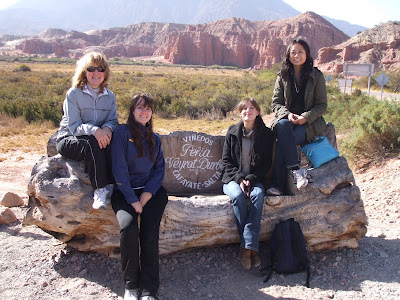
As I was there for only four days I didn’t have the chance to visit many places, but the few I did see fascinated me. We went on three excursions: the first one took as to Jujuy, where we visited the amazing village called Purmamarca with its famous hill of seven colours, and, a bit further, the absolutely astonishing “Salinas” – mother nature: you’re a genius! The second one had Cafayate as its final destination, but the real attraction was to way there: the mountains, the colours, the rocks… everything was just breath taking. And the last one was to a small peaceful village called Cachi. The place is incredibly gorgeous and relaxing, and, on our way back we could even enjoy the snow!

As the saying goes “When in Rome, do as Romans do”, so I decided to eat Salta’s typical food, and I strongly recommend you that, if you ever go there, you give everything a try. You just can’t go wrong. Those flavored corn paste wrapped in corn leaves (called “humitas” in Spanish), tamales, desserts with goat cheese, and even those cute animals like lamas and little goats are really delicious, no matter in which way you eat them. And don’t get me started on the empanadas! (BTW, I found that they can be called “turnovers”) I tried one in each place I ate. They were all different and all unbelievably tasty. I don’t think I’ll ever it one at home again.
The inhabitants are as kind as anyone can be. No cab driver will secretly take you on a city tour so as to get more money from you, and no restaurant owner will overcharge you for food just because he has the only place to eat at the top of a hill. They are all eager to help and visibly happy to live in such a place. Tourists are warm and friendly people who make your excursions even better, and striking up a conversation with them is incredibly enriching.
I have to admit that before my trip I had never been much into our folk music, but as soon as I came back I started listening to lots of bands and singers of that genre because, in Salta, I fell in love with it. Everyone there has an amazing voice and sings those songs with such passion that is impossible not to like their performances. At “peñas”, young people ask for guitars and sing along with friends and whoever wants to join them. It is not possible to describe the brilliance of those spontaneous shows.
So, to sum up, my advice for you all is that you visit Salta whenever you have the chance. I know that we all can’t wait to go to Europe or all those places we have in mind, but sometimes visiting our country can also be an unforgettable experience.
I want to dedicate this post to two people I’ve met during my trip, who definitely put the cherry on my cake: Mariana and Ana.

Subscribe to:
Posts (Atom)